Wednesday, 11 February 2015

PORTA DE SANTIAGO (A'FAMOSA , MELAKA)

from the top of St Paul's Hill, if you take the path behind the church and descend down, you will come across an old gate at foot hill. Judging from the structure and concrete carving, it was obviously built by a European hand.
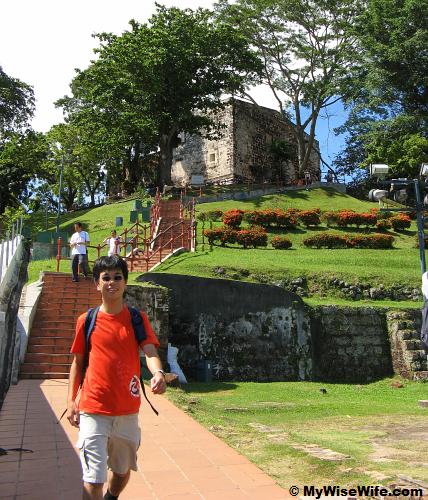
The descending path from St Paul Church
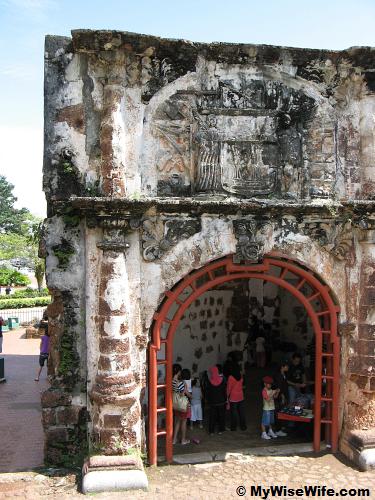

From behind - Red iron is used to sustain the structure
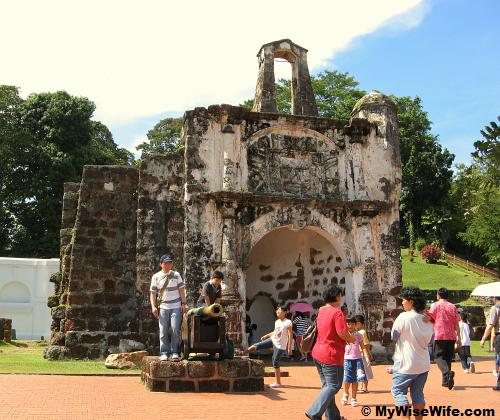

Facade of Porta De Santiago

When I was younger, I remembered this memorable Portuguese ruin was called A'Famosa which means 'The Famous' in Portuguese. According history, A'Famosa was a squarish fortress built by Portuguese in 1512 to defend the attack of the armies from Melaka Sultanate and Acheh. And Porta De Santiago was one of the four main gateway into the fortress. Portuguese capitalized on slave labor to construct the fort's walls of 3 m thick surrounding St Paul's Hill using parts from demolished palaces, royal mausoleums, mosques and tombstones. A watchtower of 40 m high was once stood at Northeast corner of this fortress. Inside the fortress, there were churches, Governor's residence, administration complex, hospitals and other amenities exactly like a well-guarded small village. 

According to hearsay, during Dutch attack, A'Famosa fortress was a brilliant shield and manage to hold intact but Portuguese finally lost in the battle due to starvation rather than a failed defense. 

After Dutch took over, the fortress was rebuilt and renamed as Dutch East Indian Company or 'Verenigde Oostindische Compagnie' (VOC). 
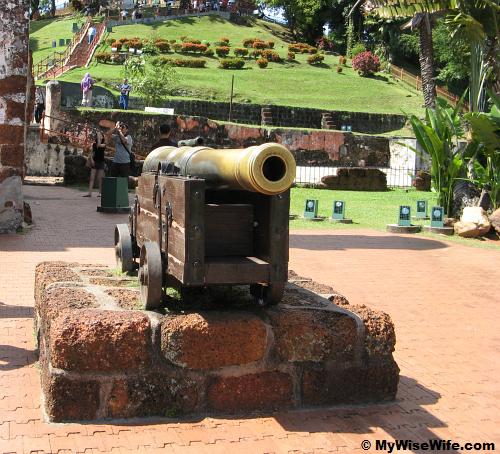
One of the few canons within the vicinity

During British era in 1795, the A'Famosa fortness was ordered to be destroyed for the fear to be used against them when Melaka was handed back to Dutch after Napolean War. Thanks to Sir Stamford Raffles for his timely intervention in 1808 and the demolition stopped. Only Porta De Santiago survived from the damage. Somehow, Dutch never return. Instead, Dutch offered British to exchange Melaka with Bencoolen (Bengkulu) in southwest of Sumatra.
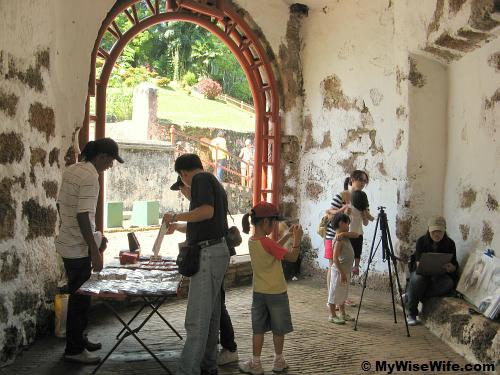
Some interesting corners inside

And the ruin we see today at Istana Road  (Fort Terrace) in Melaka is the gate of Porta De Santiogo built by the the first European conqueror in Malaysia and also the last surviving gift of the old Portuguese architecture. A picture with Porta De Santiago is a must otherwise you will not consider yourself visiting Melaka.
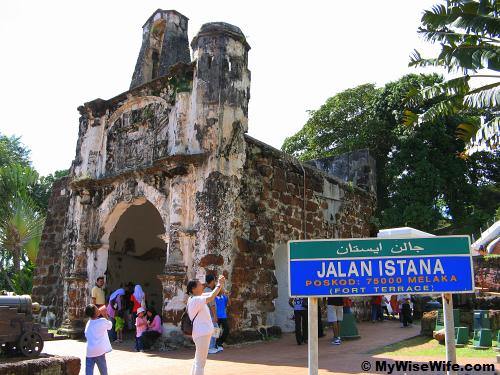

Porta de Santiago along Fort Terrace in Melaka


COPY FROM : http://www.mywisewife.com/

Tuesday, 10 February 2015

THE STADHUYS , MELAKA

The Stadthuys, Melaka, Malaysia - In-sight.

   
27 (1 of 1)
The Stadthuys is located at what is now called the Dutch Square, on Jalan Kota (Kota Road).
28 (1 of 1)On top is Pokok Melaka (Indian Gooseberry) Tree. It had a wonderful story from a Hindu Prince Paramesawa in the 1600s who was hunting for a deer. He rested under a tree by the river. He saw one of his dogs corner a deer but was startled when the deer defended himself and pushed the dog to the river. He was inspired by the circumstances of the weak overcoming the powerful. At that moment he decided to found a kingdom and named it after the tree he was sitting on.

The Stadthuys, which means the Municipal Town Hall in Dutch, is the biggest, most prominent building in the Malacca Town Square, and it is also the oldest and biggest Dutch colonial building in Southeast Asia.
25 (1 of 1)Outside view of Stadthuys.
Construction of it began around 1641, the year the Dutch pried Malacca from the Portuguese, who ruled since the fall of the Malacca Sultanate in 1511. It covers 49,000 square feet. It took close to twenty years to complete it, with building material imported from the Netherlands.
26 (1 of 1)The counter of The Stadthuys : These are open to the public from 9 a.m. until 6 p.m. daily except on Fridays when they close from 12.15 p.m. until 2.45 p.m. for lunch and Friday prayers.
Admission fee is RM2 at time of writing.
The subsequent British governors continued to favour Stadthuys as a civic centre. As late as 1979, the Malaysian government used the building as the State Governing Centre. Since then, the building has been converted into the Ethnography Museum. Although the interior is now filled with museum exhibits, it is still possible to view much of the interior with its thick masonry walls and heavy wooden beams.
2 (1 of 1)
Although the interior is now filled with museum exhibits, it is still possible to view much of the interior with its thick masonry walls and heavy wooden beams.
The statue of Admiral Cheng Ho (Zheng He) stand incongruously on the courtyard, commemorating the admirals' visit to Malacca during the time of the Malacca Sultanate.
16 (1 of 1)
18 (1 of 1) 
All the buildings here wear a coat of maroon paint, giving the square a decidedly foreign feel not found anywhere else in Malaysia.
15 (1 of 1)
 Stadthuys – Inner courtyard, the statue of Admiral Cheng Ho in the middle
During the Dutch rule of Malacca, the Stadthuys, like all the other Dutch administration buildings in Southeast Asia, was painted white. By way of the Anglo-Dutch treaty of 1824, Malacca was given up by the Dutch and the town became a British colony. In 1911, the British painted the Stadthuys and the Christ Church a salmon red.
17 (1 of 1)
Stadthuys – Inner courtyard

Recent excavation revealed that beneath the Stadthuys there used to be a Portuguese settlement. A Portuguese well and drainage system were discovered. The remains of the A Famosa, the fort that the Portuguese built right after seizing Malacca, is believed to be buried under the Stadthuys car park today.
Today, the Stadthuys houses three museums: the History Museum, the Ethnography Museum and the Literature Museum.
29 (1 of 1)The thick masonry walls, heavy solid wood doors and windows, with their wrought iron hinges, are eloquent testimony to the solidity of the Dutch masonry and craftsmanship.

An outstanding example of colonial Dutch architecture, this edifice now houses the History Museum and Ethnography Museum.
3 (1 of 1)
4 (1 of 1)
5 (1 of 1)
6 (1 of 1)
7 (1 of 1)
8 (1 of 1)
      9 (1 of 1)
10 (1 of 1)
6th century Dutch and 18th century Japanese porcelain, guns, muskets, swords, various ‘Keris’.

11 (1 of 1)
13 (1 of 1)
Dutch Blackwood cupboard made bearing the monogram of the Dutch East India Company (VOC).

14 (1 of 1)Ming porcelain ware, white -blue colored Ching porcelain ware, high quality glazed Islamic ceramics, Nyonya ware with peculiar pink, yellow, dark blue and green colors, Swatow ceramics, Sukhothai and Sawankhalok ceramics.

On display are traditional bridal costumes and relics from Melaka's over 400-year history. Both museums are well-laid out and offer detailed explanations of how these costumes and relics played their part in Melaka's glorious past.
22 (1 of 1)
21 (1 of 1)
23 (1 of 1)  
24 (1 of 1)

A recently erected plaque inside the Stadthuys reads as:
“TO THE CITY OF MALACCA
THE RESTORATION OF THIS STADTHUYS
CONNECTS OUR PAST WITH A JOINED
FUTURE AS SISTER CITIES.
THE CITY OF HOORN.
P.M.G.P.JANSSENS, MAYOR
A.G.M. MOCK.  CITY – CLERK
14 AUGUST 1990.”

melaka Map
The map of The Stadthuys, Melaka.


COPY FROM : http://malaysianoyks.blogspot.com/